Why speed matters
A child on a regular bike usually cruises at about 10 mph. E-bike motors push riders to 20 or 28 mph. That extra speed changes everything about a crash.
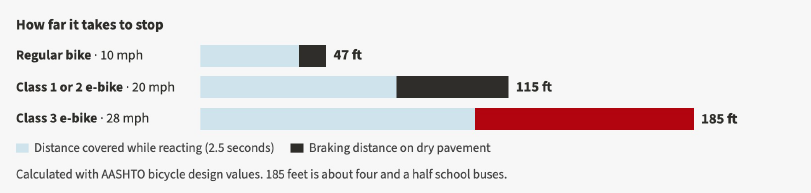
- Less time to react. At 28 mph, a rider covers 41 feet every second—about 103 feet before braking even begins.
- Harder hits. Crash energy grows with the square of speed. Twice the speed means four times the energy, and 28 mph carries almost eight times the energy of 10 mph. A heavier bike adds even more.
- More serious injuries. In children's e-bike crashes that involved speed, internal injuries—mostly to the head—were more than twice as common.
Use your head: protect your brain
Head injuries are among the most serious injuries seen in e-bike crashes. A properly fitted helmet on every ride is the single most effective way to protect your child's brain.
- It's the law. California requires a helmet for every rider under 18 on any bicycle or e-bike, and for riders of all ages on a Class 3 e-bike.
- Match the helmet to the speed. Regular bicycle helmets are designed for lower speeds. For e-bikes, choose a helmet certified to the NTA 8776 e-bike standard—it covers more of the head and is tested for harder impacts. For an e-moto or any bike that goes faster than 28 mph, a DOT-certified motorcycle helmet is the right choice.
- Fit matters as much as the helmet. Try the Eyes, Ears and Mouth Test on our Bicycle Safety page.
- Replace any helmet after a crash, even if it looks fine.
Bike helmet (CPSC)
Regular bikes, scooters, skating, and lower-speed Class 1 and 2 e-bikes.
|
E-bike helmet (NTA 8776)
Class 3 e-bikes and e-scooters up to 28 mph. More coverage, higher-speed testing.
|
Full-face or motorcycle helmet (DOT)
E-motos and any bike faster than 28 mph. Protects the face and jaw too.
|
Is your teen ready for an e-bike?
The developing brain
Children and teens are still learning how to spot danger, judge risk, and make quick decisions. The parts of the brain that control impulses and weigh consequences keep maturing into the mid-to-late 20s. Young riders also notice hazards later and react more slowly than experienced adults—and at e-bike speeds, every half-second matters. Age alone does not determine readiness; parents should weigh their child's maturity, judgment, and riding experience.
What the American Academy of Pediatrics recommends
- Under 12: No e-bikes. Children this age should not operate anything that goes faster than 10 mph.
- Ages 12 to 15: Only if you decide your child is ready—and only a Class 1 e-bike.
- Age 16: Start with a Class 1 or Class 2 e-bike.
- Every rider: A helmet made for higher speeds, every ride. Being able to ride a regular bicycle does not automatically mean a child is ready for an e-bike.
Ask yourself: Does my teen…
- Wear a helmet properly on every ride—without being reminded?
- Know the rules of the road and follow them without reminders?
- Ride predictably and watch for hazards—car doors, driveways, turning cars?
- Stay off the phone and keep the earbuds out?
- Handle unexpected traffic situations calmly?
- Say no when friends push for wheelies, racing, or riding double?
Remember: Safe e-bike riding takes skill, good judgment, and maturity. If the answer to any question is "Not yet," your teen is not ready for an e-bike yet, either.
Learn the rules of the road, and obey all traffic laws
- Ride on the right side of the road, with traffic, and use the bike lane where there is one. Drivers are not looking for wrong-way riders.
- Stay off the sidewalk. E-bikes belong on the road or in bike lanes; many cities ban sidewalk riding, and state law limits e-bike speed on any sidewalk to 10 mph.
- Stop at every stop sign and red light, use hand signals, and look back before turning or changing lanes.
- Slow down near pedestrians, driveways, and intersections. Drivers do not expect a bike moving at 28 mph.
- One rider per seat. No passengers unless the bike was built for two.
- No phone in hand and never earbuds in both ears.
- At night, use a white front light, a red rear light or reflector, and reflectors on the wheels and pedals. Wear light or reflective clothing.
- Never modify an e-bike to go faster or disable its speed limiter.
Battery and charging safety
- Use only the battery and charger designed for your e-bike, and look for batteries certified to UL 2849 or UL 2271.
- Check the battery regularly for damage, swelling, or overheating. Stop using a damaged battery.
- Charge in a dry, open area away from exits and anything that can catch fire. Never charge while sleeping, and unplug when fully charged.
- Never modify or tamper with the battery.
Create a parent–teen e-bike agreement, and stay involved
Set clear rules before the first ride, and review them regularly:
- Helmet on every ride—no helmet, no ride.
- No passengers, no phone, no earbuds.
- Where riding is allowed, how fast, and whether riding after dark is OK.
- Consequences for unsafe riding, including losing the bike for a while.
- Talk with your teen about safe riding, and be aware of risky riding trends on social media.
- Learn basic e-bike maintenance, and visit a local bike shop if you have questions.
- Register your e-bike and battery, and check the U.S. Consumer Product Safety Commission recall website for alerts involving e-bikes, batteries, and chargers.
Learn safe riding skills
- Enroll your teen in an e-bike safety course.
- The California Highway Patrol offers free online e-bike safety training.
- Practice in an empty parking lot or park before riding in traffic—braking from speed, turning, and shoulder checks.
- Bring your child to one of our community helmet-fitting events. Community Classes >


 MyChart


Connect with us:
Download our App: